
The History of the Four-Poster Bed
By the Kinky Beds teamPublished 3 min read
Quick answer
- Four-poster beds grew out of medieval curtained beds that kept sleepers warm and gave them privacy.
- The canopy (called a "tester") and curtains were the point; the posts held them up.
- By Tudor times they were status symbols. The Great Bed of Ware, made around 1590, is the famous example.
- Today the four-poster's ideas, privacy, drama and a strong frame, live on in modern bed design.
Few pieces of furniture carry as much history, or as much romance, as the four-poster bed. Its story is really a story about two things people have always wanted from a bedroom: warmth and privacy.
Medieval beginnings
In medieval Europe, even wealthy households had little privacy. Great halls were shared spaces, and rooms were cold and draughty. The solution was to enclose the bed itself. Wooden frames supported a canopy overhead and heavy curtains on every side, creating a small, warm, private room within a room. Drawn closed at night, the curtains kept out draughts, light and, to an extent, prying eyes.
The tester and the posts
The canopy over a four-poster is traditionally called a tester. Early designs often hung the tester from the ceiling or fixed it to a tall headboard; over time, four corner posts became the standard way to hold it up. A "half-tester" has a canopy that covers only the head end of the bed, supported by the headboard rather than four posts.
Tudor and Elizabethan status symbols
By the sixteenth century, the bed had become one of the most valuable things a household owned, often passed down in wills. Elaborately carved oak posts, rich fabrics and embroidered hangings showed off wealth. The most famous example is the Great Bed of Ware, an enormous carved oak four-poster made around 1590 and now at the Victoria and Albert Museum in London. It was famous enough in its day to be mentioned by Shakespeare in Twelfth Night.
Georgian elegance
In the eighteenth century, four-posters became lighter and more elegant. Mahogany replaced heavy oak in fashionable homes, posts became slender and fluted, and the hangings grew lighter as homes became warmer. Furniture designers of the period published pattern books with designs for beds that are still copied today.
Victorian change
The Victorians had mixed feelings about heavy bed curtains. Concerns about dust and fresh air, along with new materials, led to the popularity of iron and brass bedsteads. The full four-poster became less common, though canopy and half-tester beds remained in grand houses.
The modern four-poster
Today's four-posters are mostly about style rather than warmth: minimal metal frames, clean timber posts, sometimes a sheer drape. They still signal that the bed is the centrepiece of the room, and their posts still make them a popular choice for couples who want something more than an ordinary bed.
| Period | Typical design | Purpose |
|---|---|---|
| Medieval | Wooden frame, canopy, heavy curtains | Warmth and privacy |
| Tudor and Elizabethan | Carved oak, rich hangings | Status and display |
| Georgian | Slender mahogany posts, lighter drapes | Elegance and fashion |
| Victorian | Iron and brass bedsteads, half-testers | Hygiene and new materials |
| Modern | Minimal metal or timber, optional drapes | Style and statement |
The four-poster's ideas, reimagined
Look past the posts and the four-poster's real ideas are privacy, a sense of occasion and a strong frame at the centre of the room. A modern bed with hidden restraints takes the same ideas in a different direction: it looks like a contemporary designer bed by day, while keeping its second purpose discreetly out of sight. Our comparison of four-poster beds vs restraint beds covers the practical differences.
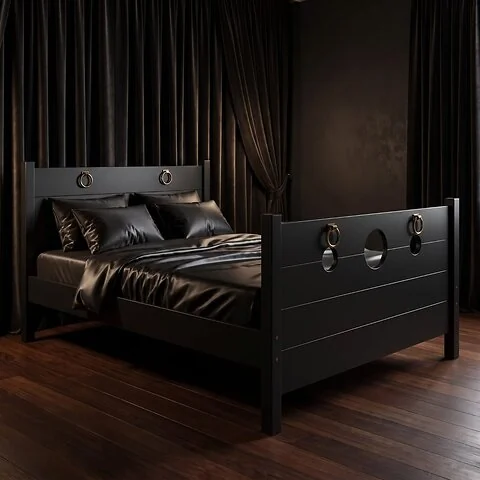
The Sovereign Bed
From £599.00 · Free UK delivery
- Restraint rings hidden behind interchangeable decorative panels that swap in under 60 seconds, no tools
- Solid hardwood frame with a 150kg load rating
- Double (4ft 6in) or King (5ft), for standard UK mattresses up to 30 cm deep
- Onyx Black or Alabaster White · plain, unmarked packaging · 14-day returns
Frequently asked questions
Why did four-poster beds have curtains?
To keep sleepers warm and give them privacy in cold, shared medieval and Tudor homes. The posts existed to hold up the canopy and curtains.
What is the canopy on a four-poster bed called?
Traditionally a tester. A half-tester covers only the head end of the bed.
What is the Great Bed of Ware?
A huge carved oak four-poster made around 1590, now at the Victoria and Albert Museum in London, and mentioned by Shakespeare in Twelfth Night.