
Four-Poster Bed vs Restraint Bed: Which Is Right for You?
By the Kinky Beds teamPublished 3 min read
Quick answer
- Four-posters make a statement and have obvious tie points, but they're tall, visually dominant and not always built for pulling forces.
- A hidden-restraint bed looks like a normal designer bed and anchors restraints to the frame.
- In smaller or lower-ceilinged UK rooms, a hidden-restraint bed is usually easier to live with.
Four-poster beds have long been the romantic choice for couples, partly because those four posts are so obviously useful. But a four-poster isn't the only option, and it isn't always the best one. Here's how it compares with a bed that has hidden restraints.
Looks and presence
A four-poster is a statement. It fills the room vertically and draws the eye, which can look wonderful in a large room with high ceilings. In a typical UK bedroom with a ceiling of around 2.4 m, it can feel imposing. A hidden-restraint bed has the footprint and profile of a normal bed, so it suits a wider range of rooms.
Discretion
Nobody thinks twice about a four-poster, but anything tied to the posts is on show. A concealed restraint bed hides its anchor points completely when not in use, so there's nothing to explain.
Strength where it matters
Four-poster posts are designed to stand upright and hold a canopy, not necessarily to take a sideways pull at the top. Some are very sturdy; many lightweight metal designs are not. If you plan to attach restraints, ask the maker whether the posts are rated for it. A restraint bed is designed with anchor points fixed into its structure. See weight capacity explained.
Side by side
| Four-poster bed | Hidden-restraint bed | |
|---|---|---|
| Look | Tall, dramatic, traditional or modern | A contemporary bed |
| Room fit | Best with high ceilings and space | Fits most bedrooms |
| Tie points | Posts (visible) | Built-in, concealed |
| Designed for restraint loads | Depends on the model | Yes, by design |
| Discretion | Restraints visible when attached | Hidden when not in use |
| Assembly | Often tall, heavy parts | Standard bed assembly |
Which should you choose?
Choose a four-poster if you love the look, have the ceiling height and floor space, and are happy with visible tie points (or plan to use under-mattress straps). Choose a hidden-restraint bed if you want restraints built in but invisible, a bed that fits a standard room, and anchor points designed for the job.
The Sovereign Bed
The Sovereign Bed is our take on the second option: a solid hardwood frame with restraint rings behind decorative panels that swap in under 60 seconds with no tools, a 150kg load rating, and a choice of Double or King in Onyx Black or Alabaster White.
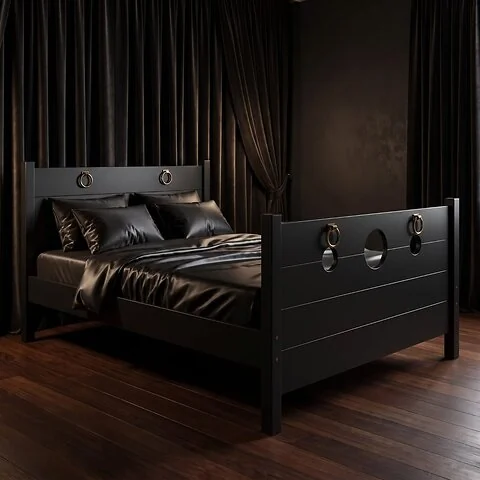
The Sovereign Bed
From £599.00 · Free UK delivery
- Restraint rings hidden behind interchangeable decorative panels that swap in under 60 seconds, no tools
- Solid hardwood frame with a 150kg load rating
- Double (4ft 6in) or King (5ft), for standard UK mattresses up to 30 cm deep
- Onyx Black or Alabaster White · plain, unmarked packaging · 14-day returns
Curious where the four-poster came from? Read the history of the four-poster bed.
Frequently asked questions
Are four-poster beds good for restraints?
Some are, if the posts are strong and rated for sideways pulling. Many lightweight designs aren't. Ask the maker, or choose a bed with restraint points built into the frame.
Will a four-poster bed fit in a small bedroom?
It can feel imposing in a small room or under a low ceiling. A bed with hidden restraints has a normal bed's profile, so it suits more rooms.
What is a good alternative to a four-poster bed?
A bed with concealed restraint points looks like a contemporary designer bed and keeps its restraints hidden until you want them.
This guide is general information for adults, not medical or legal advice. If anything feels wrong during or after restraint play (lasting numbness, pain or anxiety), stop and seek medical advice. Questions about The Sovereign Bed: support@kinkybeds.com.