How to Set Up Under-Bed Restraints, Step by Step
By the Kinky Beds teamPublished 7 min read
Quick answer
- Lay the straps flat under the mattress with the centre roughly in the middle, then pull a strap out at each corner.
- Clip on empty cuffs and test every release before anyone is restrained.
- Keep slack in each strap, two fingers under each cuff, and safety shears nearby.
- If set-up is a faff every time, a bed with integrated restraint points removes the step.
To set up under-bed restraints, take the mattress off or lift it, lay the strap system flat across the bed base with the central ring or join roughly in the middle, replace the mattress and pull a strap out at each corner. Clip empty cuffs on, test every release, adjust for your partner's height, and only then put the cuffs on. Keep slack in the straps, safety shears within reach and check in throughout.
What an under-bed restraint system is
An under-bed (or under-mattress) restraint system is a set of straps that sits beneath the mattress, held in place by its weight, with a cuff or clip point at each corner. It works on most beds without fixing anything to the frame. For the pros and cons compared with built-in options, see under-mattress straps vs a restraint bed and our bed restraints buying guide.
Before you start
- Read the instructions that came with your kit.
- Check the straps and buckles for wear.
- Make sure the bed base is solid and has no sharp edges the straps could rub on.
- Put safety shears by the bed.
- Agree a safe word and a non-verbal signal. See safe word ideas for couples.
Step by step
- Clear the bed. Remove pillows and the duvet.
2. Lift or remove the mattress. It is easier with two people.
3. Lay the straps flat. Position the centre roughly in the middle of the base, with straps running towards each corner. Make sure none are twisted.
4. Replace the mattress. Check the straps have not bunched.
5. Bring the ends out. Pull each strap out at the corner, or along the sides if you prefer a different position.
6. Clip on empty cuffs. Test that each buckle or clip opens easily with one hand.
7. Adjust for height. Have your partner lie down, uncuffed, and set each strap so arms and legs rest comfortably without stretching.
8. Cuff on. Fit each cuff with two fingers of space underneath, then clip it to the strap.
Positions
Arms above the head
Bring the top straps out near the head of the bed. Keep the elbows bent and the arms resting on a pillow, and bring them down every ten to fifteen minutes.
Spread position
Bring all four straps out at the corners for wrists and ankles. Leave slack so your partner can shift their weight, and support the lower back with a pillow if needed.
Wrists only
Use just the top two straps, or clip the wrist cuffs together. The gentlest place to start.
Safety during play
- Check hands and feet every few minutes for numbness, tingling, coldness or colour change.
- Avoid pressure on the inner wrist.
- Never leave a restrained partner alone.
- Stay sober and keep sessions short at first.
- Release immediately if the safe word or signal is used.
Our restraint safety checklist has the full list.
Packing away discreetly
Many kits can stay under the mattress with the ends tucked in. Wipe cuffs down, let them dry and store them in a breathable pouch. See cleaning and caring for restraints and how to store intimate accessories discreetly.
Common problems and fixes
- Straps slide out: the mattress may be too light or the base too slippery. Tighten the central adjustment or check the instructions.
- Cuffs too tight or loose: re-fit using the two-finger rule.
- Straps rub on the frame: reposition so they do not cross sharp edges.
- Set-up kills the mood: do it earlier in the day, or consider a bed with integrated restraint points.
When a restraint bed makes more sense
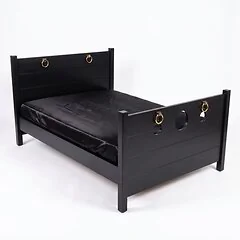
If you use restraints regularly, setting up straps each time can become a chore. A bed with integrated, concealed restraint points is always ready and looks like an ordinary bed the rest of the time. Read how hidden restraints work and how to choose a bed with hidden restraints.
Choosing an under-bed restraint system
Under-bed or under-mattress systems vary a lot, and the right one depends on your bed and how you plan to use it. Before buying, check:
- Fit: the straps need to suit the width and depth of your mattress. Very deep or very wide mattresses may need extension straps.
- Adjustability: every strap should adjust easily, so you can find comfortable positions for different heights and builds.
- Cuffs: look for padded cuffs that fasten securely but can be undone quickly, ideally with a quick-release clip on the connecting strap.
- Cleaning: materials that wipe clean are easier to keep hygienic.
- Storage: decide whether you will leave the straps in place under the mattress or remove them after each use, and choose accordingly.
Our bed restraints buying guide compares the main options in more detail.
A quick pre-session check
Under-mattress straps can move, loosen or wear over time, so a thirty-second check before each session is worth building into your routine.
- Lift the corners of the mattress and make sure each strap is flat and centred, not twisted or caught.
- Tug each anchor point firmly: nothing should slide or come away.
- Inspect every cuff and clip for fraying, cracks or loose stitching.
- Fit the cuffs loosely to your partner first, then adjust the straps, rather than pulling a limb to reach a cuff.
- Put the safety shears and a blanket within reach, and agree the safe word again.
If anything looks worn or damaged, replace it before you use it again. A restraint that fails mid-session is not dangerous in itself, but it can cause a fall or a jarred joint.
Fitting straps to different mattresses
Thicker mattresses and divan bases can make under-bed straps harder to position. Run the straps as close to the head and foot of the mattress as you can, so the cuffs sit naturally at the corners without stretching. If the straps tend to slide on a smooth base, a thin non-slip rug underlay between mattress and base can help them stay put. Whatever your bed, never position a strap so that it pulls a limb into an awkward angle; move the cuff or the person, not the joint.
Frequently asked questions
Do under-bed restraints work on any bed?
They work on most beds with a mattress heavy enough to hold the straps. Check your kit's instructions and make sure there are no sharp edges for straps to rub against.
Can under-bed restraints stay on the bed?
Many can stay beneath the mattress with the ends tucked away, which makes them quick to use and discreet.
How tight should the cuffs be?
You should be able to slide two fingers between the cuff and the skin. Check circulation every few minutes.
Are under-bed restraints good for beginners?
Yes. They are one of the easiest ways to start, because they need no knots and no fixings, and the cuffs can be released quickly.
Can under-bed restraints damage the mattress?
They should not if laid flat and not twisted. Check your mattress manufacturer's guidance and avoid straps crossing sharp edges of the base.
How do we stop the straps showing?
Tuck the ends under the mattress or between the mattress and the frame when not in use, and keep cuffs in a lidded box.
What height of mattress works best?
Most kits work with standard mattress depths. Very thin or very light mattresses may let straps slide; check your kit's instructions.
Can I leave under-bed restraints fitted all the time?
Many people do, tucking the straps under the mattress between uses. Check them regularly for wear, and remove them if guests will be making the bed.