
The Best Beds for Shared Kids' Bedrooms
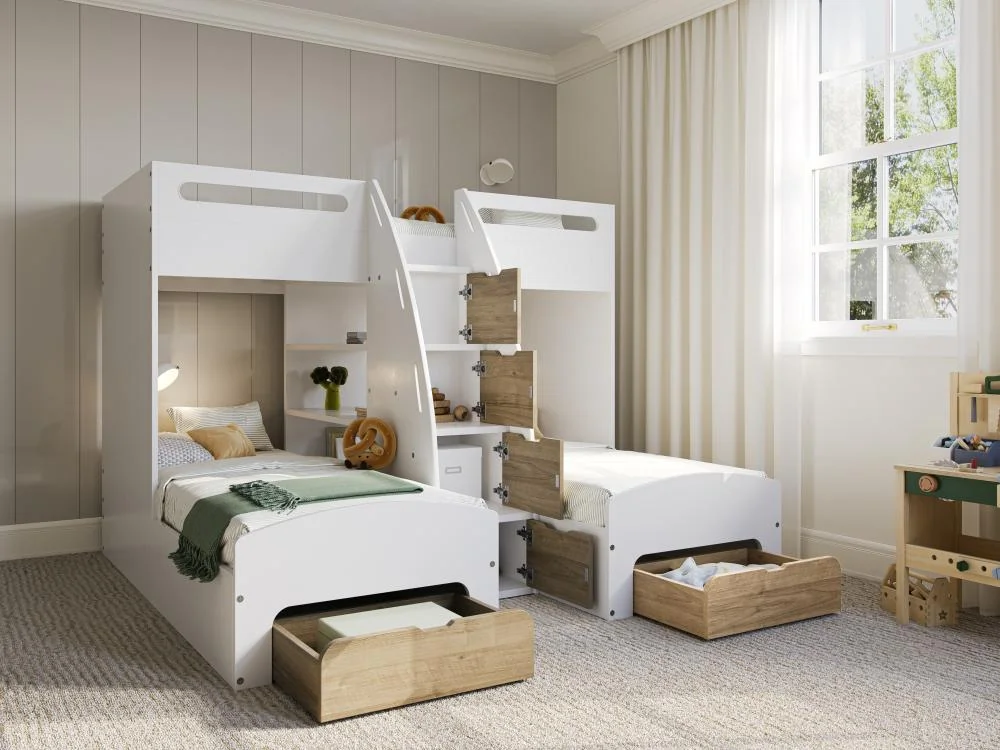
Two children, one bedroom and never quite enough floor space, that's the reality for a lot of families. The right kids' bed does more of the work than people expect, deciding how much space is left over for everything else and how well two children actually share the room day to day. Here are the options worth considering, whatever the room size or age gap you're working with.
How much floor space do you actually need?
It's worth measuring the room properly before falling for a particular bed style. A single bed typically needs around two metres by one metre of floor space once you account for making it up comfortably, so two side by side can eat into a small room fast. Bunk beds solve that by using the same footprint as a single bed for two children, which is usually the deciding factor once a tape measure comes into play. Leave a little extra room around any bed for getting in and out, rather than measuring to the mattress edge.
Shared bedroom bed ideas
Bunk beds remain the most space-efficient option for two children in one room, but they're not the only route worth considering. An L-shaped layout, a trundle bed, or two singles on opposite walls can all work, depending on the room shape and how the children get on. What matters most is matching the bed to the room rather than picking whatever looks best online first.
- Stacked bunk beds: Two beds in one space, the standard choice for smaller rooms.
- L-shaped bunk beds: Beds set at an angle rather than straight on top of each other, useful in an oddly shaped room.
- Beds with a trundle: One bed with a second pulled out from underneath, handy when full-time bunking isn't needed.
- Two single beds: The simplest option, where the room allows it, with no stacking involved.
Our L-shaped bunk beds and single beds offer alternatives to a standard bunk if stacking two beds doesn't suit your room.
Best bunk beds for kids
A good bunk bed comes down to a handful of things: a sturdy frame, secure guard rails on the top bunk, and a ladder or staircase that suits the child using it. Wooden frames feel more substantial and suit most bedroom styles, while metal frames are usually lighter and a good fit for compact rooms. Storage is worth considering too, since drawers or shelving built into the base or the steps make good use of space that would otherwise sit empty.
- Bunk beds with storage: Drawers or shelving built into the frame, useful when a small room has nowhere else to put things.
- Bunk beds with stairs: A staircase instead of a ladder, giving a steadier climb for younger children.
- Wooden bunk beds: A sturdier look that tends to suit older children's rooms well.
- Metal bunk beds: Typically have lighter frames and are often a good fit for a more compact room.
- Triple bunk beds: Built for three children sharing, or a family expecting a third to move in eventually.
Browse our full range of bunk beds and triple bunk beds to compare the options, or read our bunk bed buyer's guide for more details on choosing between them.
Bunk bed room divider ideas
A bunk bed doesn't have to sit flat against one wall. Turned side-on and placed across the middle of the room, it splits the space into two clear zones without losing an inch of floor. It's a great trick for a room where each child wants some separation, but there's no space for a proper partition. A curtain along the open side adds privacy without any building work, and a frame with a solid end panel, rather than an open one, does the same by blocking sightlines between the two sides.
Split bunk bed room divider ideas
Some bunk beds are designed to split into two single beds, offering a different way to divide a shared room. Rather than stacking the beds together, position the two singles on opposite walls or at either end of the room, each with its own bedside table and a bit of clear space around it. It's a good option once bunking together no longer suits the children, whether that's due to a growing age gap or simply a preference for more independence, without needing to buy new beds from scratch.
Safety points to check with a room-divider bunk bed
Moving a bunk bed away from a wall changes a few things worth checking. With no wall for support, the frame needs to be rated as freestanding and stable on every side, not just designed to sit flush against one. Keep it clear of doors and windows too, so neither child's escape route is blocked in an emergency. The top bunk should still have a full-length guardrail on any open side, including the side that now faces into the room rather than a wall. And once it's in place, give it a firm check for rocking or shifting. A freestanding bunk takes knocks from more directions than one backed against a wall.
Choosing the right bed in a shared room
Three things tend to decide the right bed for a shared room: the age gap between the children, how much floor space you've actually got, and how long the arrangement needs to last. A big age gap usually rules out stacked bunk beds, since a much younger child on the top bunk isn't ideal. Two beds of similar height side by side, or a split bunk arrangement, tend to work better there.
A small room often makes the decision for you, pushing towards whichever option stacks rather than spreads out. And if the whole set-up is only temporary, until an extension or a house move gives each child their own room, a trundle bed or a bunk that splits into two singles can save the cost of buying twice.
Planning ahead as children grow
A shared bedroom set-up rarely stays the same for years, so it's worth thinking about what happens as the children get older. Many bunk beds are designed to split into two separate singles once a top bunk is no longer the right option, so checking for this before buying can prevent a full replacement later. A trundle bed offers similar flexibility, since the pull-out base can simply be left unused rather than removed. Buying with the next few years in mind, not just the room as it is today, tends to be the better long-term decision.
Making a shared room feel like two rooms
Even with the bed decided, a few small additions help two children feel like they each have their own patch. Matching bedside tables in different colours, or a shelf assigned to each child, goes a long way without needing extra floor space. Our kids' storage beds range can help here too, since built-in storage under each bed keeps each child's belongings separate, without needing a wardrobe for each one. A bit of personality in the bedding, from our kids' bed linen range, is often the easiest way to make each side of the room feel theirs distinctly, too.